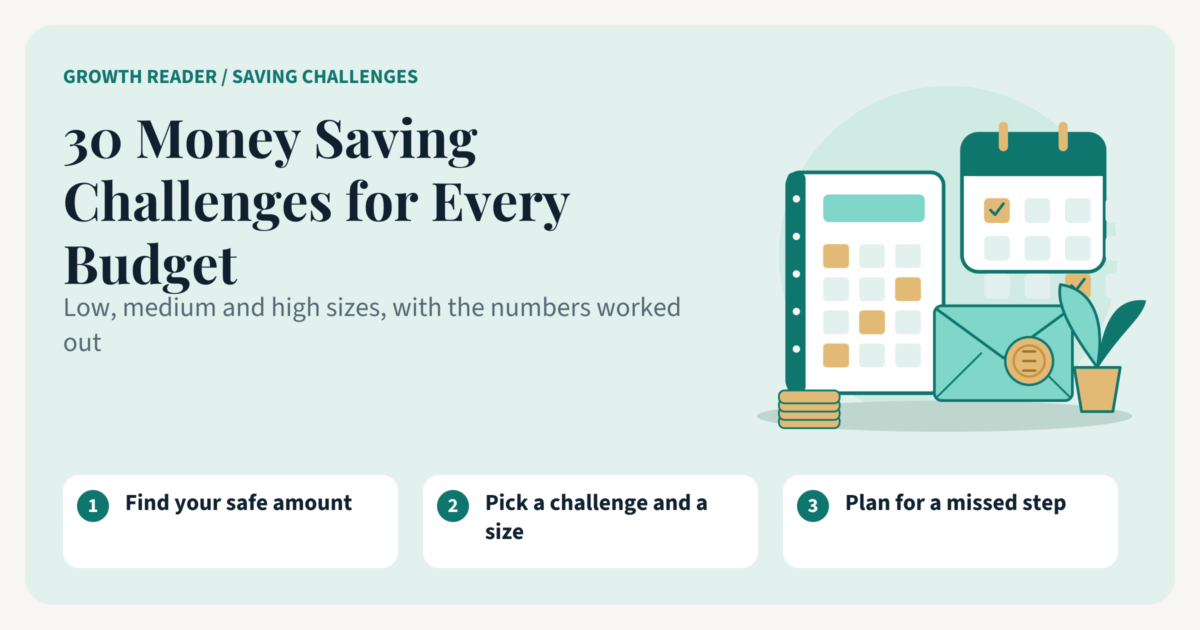
A money saving challenge is a savings rule with a start, a list of steps and a finish line. The 52-week count-up, the 100 envelope challenge and the penny-a-day challenge all follow that pattern. This guide lists 30 challenges in six groups, with a low, medium and high version of each, so you can match one to your own budget. It also shows two checks that keep you from choosing a challenge that looks good and stalls in week 20. A free tool, the Savings Challenge Picker, can narrow the list from your pay and print a plain tracker for the challenge you choose.

The totals below are arithmetic: what the steps add up to if you complete every one. They aren’t predictions, and every amount is an example.
How to choose a challenge that fits your budget
Start with one number: the amount you can move each week without touching the money your bills depend on. A simple way to find it is to look at your account balance the day before each of your last three paydays, subtract any bills still due, and plan from the lowest of the three. Then round down. The U.S. Consumer Financial Protection Bureau’s guide to building an emergency fund says even a small amount can provide some financial security, so you don’t need a large number to begin (An essential guide to building an emergency fund).
Every challenge below comes in three sizes, defined by the average week, which is the total divided by the weeks the challenge runs:
| Size | Average week | Suits |
|---|---|---|
| Low | Up to about $13 | Tight pay, a first challenge, a restart |
| Medium | About $14 to $30 | Steady pay with some room |
| High | Above about $30 | More room, or a short sprint |
These bands are our own rule of thumb, not an official standard. Use them as a starting point and compare them with your own number.
Then run two checks on any size you like:
- The average test. Is the average week at or below your safe weekly amount?
- The peak test. Find the biggest save, then the pay period it falls in. Could that whole pay period’s save come out of your safe amount for one paycheck?
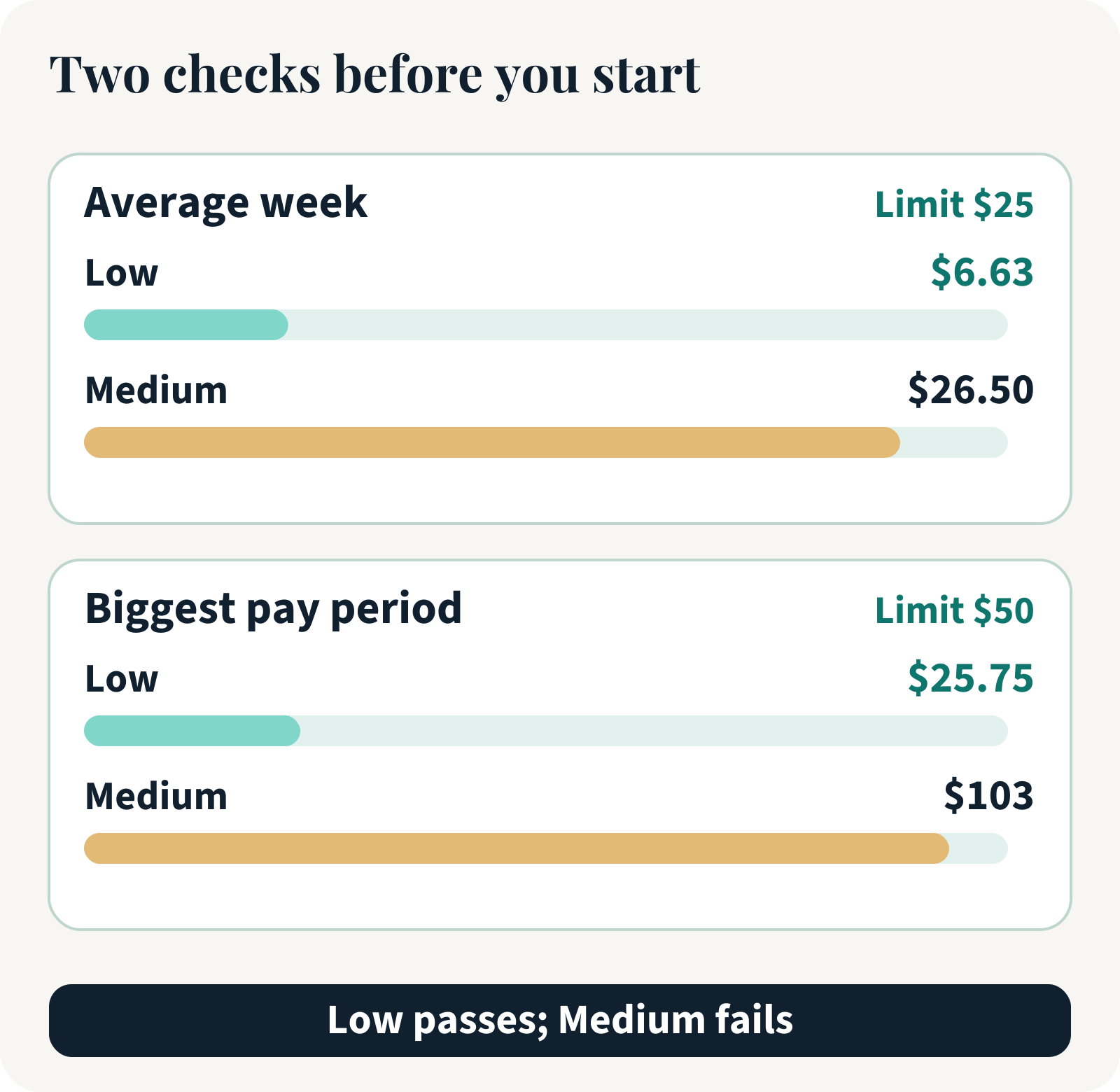
Here is how that plays out for an example reader who is paid every two weeks, with a safe weekly amount of $25 and a safe amount of $50 per paycheck. The 52-week count-up at a $1 step (the medium size) averages $26.50 a week, which is above $25, so it fails the average test. Its last two weeks add up to $103, which is far above $50, so it fails the peak test too. The same challenge at a 25 cent step averages $6.63 a week, and its last two weeks add up to $25.75, so it passes both.
The 30 challenges at a glance
Each table shows the rule in one line and the total if finished for the low, medium and high versions. A dash means the total depends on what you receive or spend.
Weekly count-ups
| Challenge | The rule | Total if finished (low / medium / high) |
|---|---|---|
| 1. The 52-Week Count-Up | Save one more step each week, from one step to 52 steps | $344.50 / $1,378 / $2,756 |
| 2. The Reverse 52-Week | The same steps in reverse, biggest first | $344.50 / $1,378 / $2,756 |
| 3. The 12-Week Sprint | Count up for 12 weeks | $78 / $312 / $624 |
| 4. The Steady Weekly Amount | The same amount every week | $260 / $1,040 / $2,600 |
| 5. The Four-Week Ladder | Climb one rung every four weeks, five rungs | $120 / $480 / $1,080 |
For the full classic with its three sizes, see The 52-Week Savings Challenge: Low, Medium and Reverse Versions Explained.
Envelope and cash challenges
| Challenge | The rule | Total if finished (low / medium / high) |
|---|---|---|
| 6. The Envelope Challenge | Fill numbered envelopes (25, 50 or 100) | $325 / $1,275 / $5,050 |
| 7. The Sinking-Fund Envelopes | Split each payday between three named envelopes | $312 / $780 / $2,080 |
| 8. The Bill Swap | Keep the $5 bills (or $5 and $10, or $5, $10 and $20) | Depends on your cash |
| 9. The Coin Jar | Empty your coins into a jar each day | Depends on your cash |
| 10. The Leftover Envelope | Move what’s left of a weekly cash amount | Depends on what’s left |
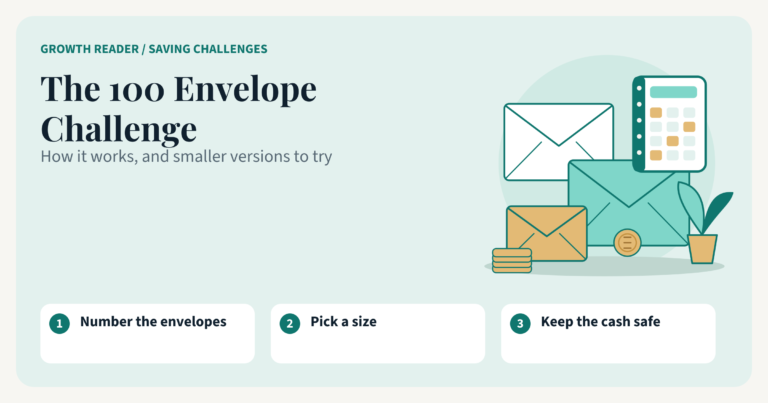
The total for challenge 7 assumes 26 biweekly paydays. For envelope sizes and pacing, see 100 Envelope Challenge: How It Works and Smaller Versions to Try.
Challenges that follow your paycheck
Payroll tables count 52 pay periods a year for weekly pay, 26 for biweekly pay, 24 for semimonthly pay and 12 for monthly pay (Publication 15-T (2026), Federal Income Tax Withholding Methods). These five use your paychecks as the steps.
| Challenge | The rule | Total if finished (low / medium / high) |
|---|---|---|
| 11. The Biweekly Count-Up | Add one step at each of 26 paychecks | $351 / $1,053 / $1,755 |
| 12. The Same Amount Every Paycheck | Move a flat amount at each payday | $390 / $910 / $1,950 |
| 13. The Percent Step-Up | Save a share of take-home pay, raised each quarter | $600 / $840 / $1,800 |
| 14. The Round-Up Transfer | Round each card purchase up and move the difference | Depends on your purchases |
| 15. Save the Raise | Save a share of a take-home pay increase | $650 / $1,300 / $1,950 |
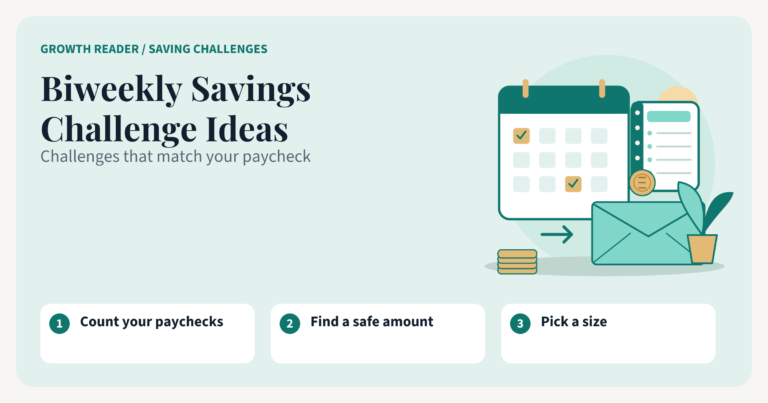
Totals for 12 assume 26 paydays. The percent step-up assumes $2,000 of monthly take-home pay, and the raise assumes an increase of $100 per paycheck. See Biweekly Savings Challenge Ideas That Match Your Paycheck for how to line these up with your pay.
Daily and calendar challenges
| Challenge | The rule | Total if finished (low / medium / high) |
|---|---|---|
| 16. The 365-Day Penny Challenge | Save one step on day 1, two on day 2, up to 365 | $667.95 / $1,335.90 / $3,339.75 |
| 17. The 30-Day Count-Up | Save one more step each day for a month | $46.50 / $116.25 / $232.50 |
| 18. The Month-by-Month Add-On | Save one step in month 1, two in month 2, up to 12 | $312 / $936 / $2,340 |
| 19. The Four-Season Goals | Fund four named goals, 13 weeks each | $312 / $780 / $2,080 |
| 20. The Seven-Day Ladder | Climb from Monday to Sunday, then reset | $364 / $1,092 / $2,184 |
Spending-pause challenges
A pause saves nothing until the money moves, so each of these asks you to move an amount on a set day. Essentials such as rent, groceries and medicine stay out of every pause.
| Challenge | The rule | Total if finished (low / medium / high) |
|---|---|---|
| 21. The No-Spend Weekend Transfer | Move a set amount for each no-spend weekend (12) | $120 / $300 / $720 |
| 22. The 24-Hour Wait List | Move part of the price of anything you skip after a day’s wait | Depends on your list |
| 23. The Subscription Pause | Pause one service for three months and move its price | $18 / $45 / $90 |
| 24. The Meal Swap | Swap a bought meal for a home meal and move the difference | $96 / $192 / $384 |
| 25. The Category Pause | Pause one spending category for four weeks | $40 / $100 / $250 |
The meal swap assumes $8 saved per swap and 12 weeks, and the subscription pause assumes $6, $15 or $30 a month for three months. Both are examples. Your own prices will differ.
Goal and game challenges
| Challenge | The rule | Total if finished (low / medium / high) |
|---|---|---|
| 26. Savings Bingo | Fill a 5 x 5 card of amounts, one square a week | $260 / $520 / $1,300 |
| 27. The Dice Roll | Roll two dice weekly and save the roll times a step | About $364 / $728 / $1,820 (average roll) |
| 28. The Coloring Chart Goal | Save one square’s amount, then color one square | $250 / $750 / $2,000 |
| 29. The Household Pool | Pool a weekly amount with a partner or roommates | $520 / $1,300 / $3,120 |
| 30. The Windfall Rule | Save a share of every unexpected payment | Depends on your windfalls |
The dice totals are averages over many rolls, not promises. At the low size the lowest possible 52-week total is $104 and the highest is $624.
A quick way to pick one
- Write your safe weekly amount and your safe amount per paycheck.
- Choose the group that matches how you’re paid. If you’re paid biweekly, start with challenges 11 and 12. If your hours vary, look at 8, 9, 10, 22 and 30.
- Choose a style: climbing numbers, a flat number, a surprise or a pause.
- Find the size that passes both tests. If two sizes pass, take the smaller one.
- Write the first four steps with dates before you start.

If you’re not sure where to begin, the beginner-friendly picks are the steady weekly amount at the low size, the 12-week sprint at the low size and the windfall rule. Low-Budget Savings Challenges for Beginners: Start With $5 a Week walks through them.
Where to keep the money
Keep challenge money apart from everyday spending, so the total is visible and a withdrawal is a choice. In the US, deposit insurance from the Federal Deposit Insurance Corporation covers deposits at insured banks up to $250,000 per depositor, per insured bank, for each account ownership category. It covers deposits only (Understanding Deposit Insurance). Cash you keep at home isn’t a deposit, so deposit insurance doesn’t apply to it. If you use cash, set a limit you’d be comfortable losing and move cash to your account when you reach it.
What to do when you miss a step
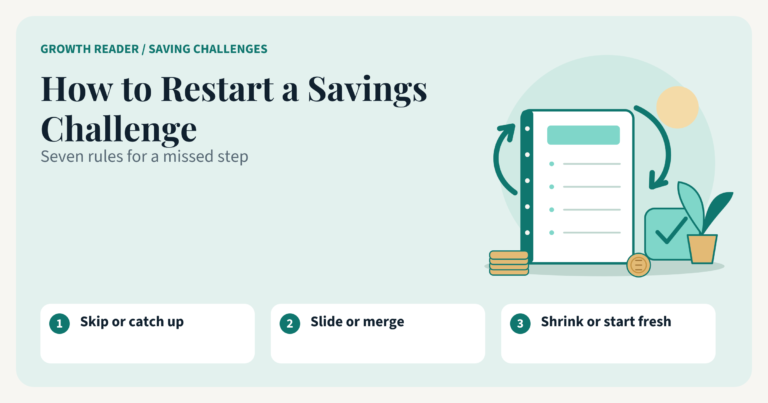
Almost every challenge hits a week when the money isn’t there. Decide your response ahead of time. The usual options are to skip the step, catch up in small pieces, slide the dates, merge two steps, shrink to a smaller size, pause on purpose or start fresh. How to Restart a Savings Challenge After You Fall Behind shows each one with the arithmetic.
Common questions about money saving challenges
Which money saving challenge is best for a beginner?
The one you’ll finish. For many people that is a low size of a flat or short challenge, such as the steady weekly amount, the 12-week sprint or the windfall rule, because none of them has a hard final week.
Do I need a separate account for a savings challenge?
You need a separate place, not necessarily a separate bank. A named sub-account, a second account or a labeled cash envelope all work. What matters is that you can see the challenge total apart from everyday spending.
Can I do two challenges at once?
Yes, once the first is running smoothly and the pair passes both checks together. Add the two average weeks and compare the sum with your safe weekly amount, then add the two biggest saves that land in the same pay period and compare them with your safe amount per paycheck.
What if I’m paid every two weeks?
Challenges 11 and 12 are built for biweekly pay. A weekly challenge also works if you save two weeks’ steps at each paycheck.
Are these totals guaranteed?
No. Each total is what the steps add up to if you complete every step. Real weeks bring bills and good news, so plan for a missed step in advance.
Your next step

Pick one challenge and write its first four steps with dates today. If you’d like a tool to narrow the list, the free Savings Challenge Picker asks a few questions about your pay and style, suggests a short list and prints a plain tracker for the challenge you choose. If you’d like ready-made tracker sheets, the Savings Challenge Tracker Pack has a sheet for each type of challenge.
For the complete 30-challenge guide with written schedules and restart rules, see Saving Challenges That Fit Your Budget.

Sources and tools used in this guide
Checked on October 12, 2026. Dollar amounts in the examples are illustrative and are not forecasts, unless a source is named.
- “An essential guide to building an emergency fund,” Consumer Financial Protection Bureau
- Publication 15-T (2026), Federal Income Tax Withholding Methods, Internal Revenue Service
- “Understanding Deposit Insurance,” Federal Deposit Insurance Corporation
This guide is general education, not financial advice. See our Disclaimer.