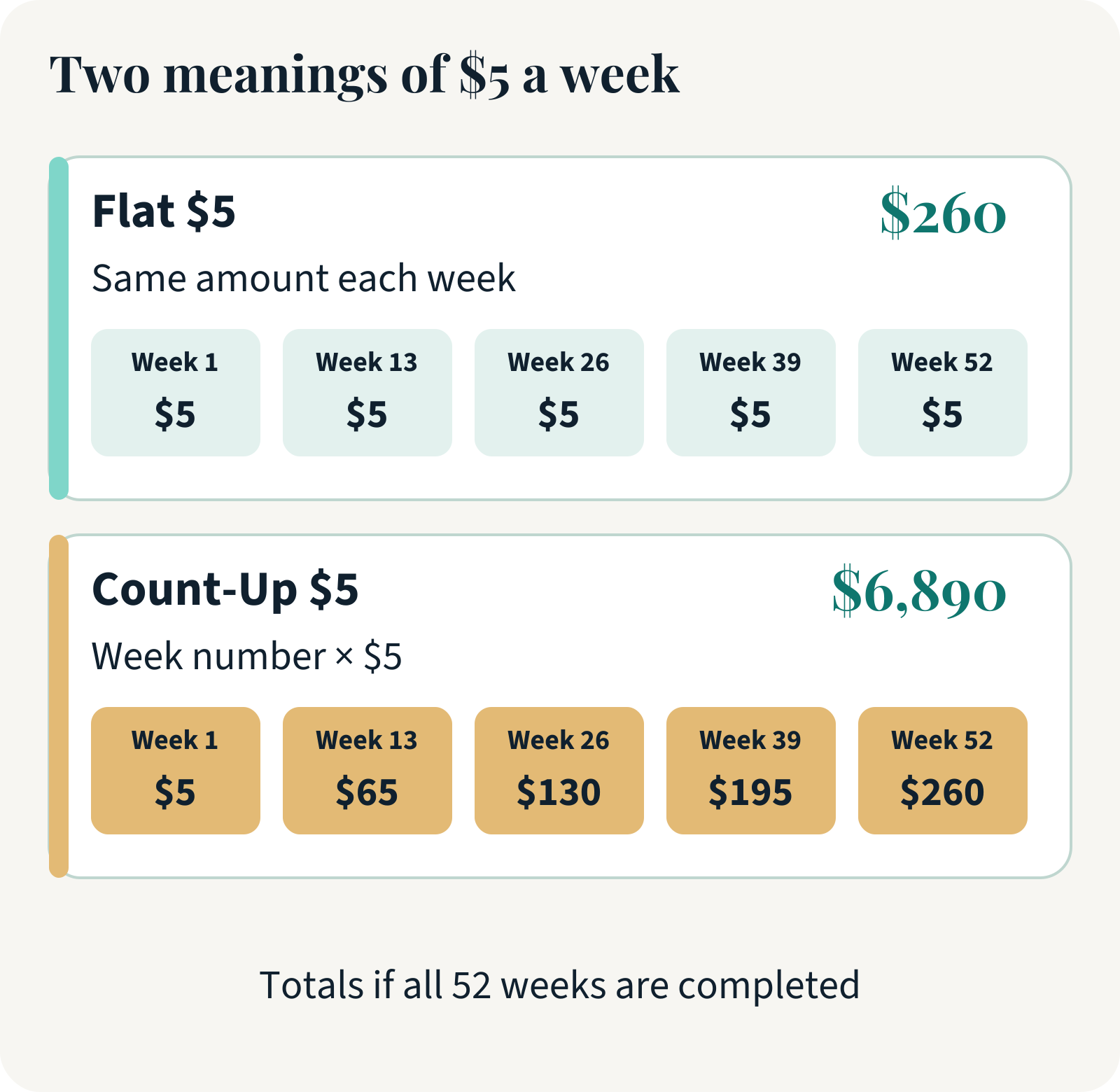
If money is tight, start with a flat $5 a week, which is $260 over a year, or with the low size of one of the five challenges below. Don’t start with a count-up that adds $5 more each week. It asks for $260 in week 52 and totals $6,890. Some lists call that version “the $5 challenge,” so check which one you’re looking at before you begin.

This guide explains the difference, shows how to find an amount that is safe for you, and gives five low-budget challenges with the arithmetic worked out. Every total is what the steps add up to if you complete every one. It isn’t a prediction, and every example is illustrative.
Two meanings of “$5 a week”
A flat $5 a week and a challenge that adds $5 each week both start at $5, and they go different places.
| Version | Week 1 | Week 26 | Week 52 | Total for the year |
|---|---|---|---|---|
| Save $5 every week | $5 | $5 | $5 | $260 |
| Add $5 each week | $5 | $130 | $260 | $6,890 |
The second version is a good challenge for a budget with a lot of room. For a tight budget, it is the wrong place to start, because the hard weeks arrive late in the year, when the excitement of starting has worn off.
Why starting small is fine
The U.S. Consumer Financial Protection Bureau’s guide to building an emergency fund says even a small amount can provide some financial security, so starting small is fine (An essential guide to building an emergency fund).
A first small cushion matters because many households have little room for a surprise. The Federal Reserve’s 2025 survey, whose report is dated May 2026, asked adults about a hypothetical $400 emergency expense. Sixty-three percent said they would cover it exclusively using cash, savings, or a credit card paid off at the next statement. That means more than a third would need another way to pay (Economic Well-Being of U.S. Households in 2025).
That figure isn’t a target for you. It’s context. For scale, $5 a week reaches $400 in 80 weeks, a little over a year and a half, and a higher amount gets there sooner.
Find a starting amount in 15 minutes
Look at your main account on the day before each of your last three paydays, and write down the balance. Subtract any bill you knew was still coming. Take the lowest of the three, then round down to an amount you can say out loud. The gap between the two is your slack for one surprise.

EXAMPLE: Sam is paid every two weeks. The day before payday, the balance was $48 last time, $22 the time before and $35 the time before that. The lowest is $22, so Sam plans on $15 a paycheck, which is $7.50 a week. A challenge fits if its average week is at or below $7.50, and its biggest pay period is at or below $15.
Run two checks on any challenge:
- The average test. Is the average week at or below your safe weekly amount?
- The peak test. Could the pay period with the biggest save come out of your safe amount for one paycheck?
Five low-budget challenges
Each of these is shown at its low size. The average week is the total divided by the weeks the challenge runs.
| Challenge | The rule | Average week | Total if finished |
|---|---|---|---|
| Steady weekly amount | Save $5 every week | $5 | $260 |
| 12-week sprint | Add $1 more each week, up to $12 | $6.50 | $78 |
| 52-week count-up | Add 25 cents more each week, up to $13 | $6.63 | $344.50 |
| Four-week ladder | $2, $4, $6, $8, then $10 a week, four weeks each | $6 | $120 |
| Windfall rule | Save the first $10 of any unexpected money | Depends | Depends on what arrives |
Steady weekly amount: $5 every week
The simplest challenge. There’s no hard week, so if the average passes, the biggest week does too. For Sam, $5 a week is $10 a paycheck, which is within $15. Over 52 weeks, that’s $260.
The 12-week sprint at a $1 step
Save $1 in week 1, $2 in week 2, and $12 in week 12. It adds up to $78. It ends in about three months, which makes it a good first run. Its biggest pay period is weeks 11 and 12, which add up to $23. That fails Sam’s $15 limit, so Sam would need the steady weekly amount instead, or the sprint with a 50 cent step ($39 total, $11.50 in the last pay period).
The 52-week count-up at a 25 cent step
The classic structure at one-quarter the size. Week 1 saves 25 cents and week 52 saves $13. The total is $344.50, and the last two weeks together are $25.75. That fails Sam’s $15 limit, which is a good reminder that the peak test catches what the average test misses.
The four-week ladder at a $2 base
Climb one rung every four weeks over 20 weeks. The rungs are $2, $4, $6, $8 and $10 a week, for $120 in all. On biweekly pay, the last rung takes $20 at each paycheck.
The windfall rule at $10
When you get money you didn’t plan on, such as a gift or the sale of something you no longer use, save the first $10 of it. There’s no schedule, so nothing can be missed. If you receive four windfalls of $10 or more in a year, it adds up to $40. It asks nothing in a month with no windfall.
Where to put the $5
Keep it in a separate place, so you can see the total and a withdrawal is a choice. A named sub-account, a second account or a labeled envelope all work. The CFPB guide says recurring transfers from checking to savings are often one of the easiest ways to save consistently. It adds that you may be able to split a direct deposit between accounts, and that you should watch your balance so an automatic transfer doesn’t trigger overdraft fees.
In the US, deposit insurance from the Federal Deposit Insurance Corporation covers deposits at insured banks up to $250,000 per depositor, per insured bank, for each ownership category (Understanding Deposit Insurance). Cash kept at home isn’t a deposit, so it isn’t covered. If you use cash for a small challenge, keep only what you could afford to lose.
Your first four weeks
| Week | One task | Moved | Total so far |
|---|---|---|---|
| 1 | Write your safe amount and name the place | $5 | $5 |
| 2 | Set a recurring transfer for the day after payday | $5 | $10 |
| 3 | Record the total in a notebook or phone note | $5 | $15 |
| 4 | Decide whether to keep $5 or try the sprint at a lower step | $5 | $20 |
What if $5 is too much some weeks?
Some weeks will be tight. Pick your response before it happens: skip the week and keep going, make up the missed $5 in small pieces over the next few weeks, or pause on purpose before a known bill. How to Restart a Savings Challenge After You Fall Behind shows each option with numbers. If a fixed weekly amount keeps failing, switch to the windfall rule, or save your loose coins, which asks only for what’s in your pocket.
When to move up a size
If you’ve finished a quarter of the challenge without a miss and the next size up would pass both checks easily, you can choose the larger size for your next challenge. Staying at the same size is also fine. The 52-Week Savings Challenge: Low, Medium and Reverse Versions Explained shows what each size looks like over a year.
Common questions about savings challenges for beginners
Is $5 a week really worth saving?
A flat $5 a week adds up to $260 in a year. The amount matters less than the habit of moving money on a schedule, which you can build on later.
Which challenge is best if I’m paid every two weeks?
A flat amount per paycheck is the simplest. For example, $10 at each of 26 paychecks equals $260. See Biweekly Savings Challenge Ideas That Match Your Paycheck for more.
What if I miss a week?
A missed week is information, not failure. Skip it, catch up in small pieces or slide your dates. Write which one you’ll use before it happens.
Do I need a bank account for a savings challenge?
No. A labeled cash envelope works for a small challenge. It isn’t covered by deposit insurance, so keep only what you could afford to lose.
Can I start in the middle of the year?
Yes. A challenge can begin on any date. Write your own start date at the top of the schedule.
Your next step

Pick one challenge and write its first four steps with dates today. If you’d like help choosing, the free Savings Challenge Picker suggests a short list from your pay rhythm and style. For a simple record, a notebook with four columns (the step, the date, the amount moved and the total so far) is enough, or the Savings Challenge Tracker Pack has ready-made sheets.

Sources and tools used in this guide
Checked on October 12, 2026. Dollar amounts in the examples are illustrative and are not forecasts, unless a source is named.
- “An essential guide to building an emergency fund,” Consumer Financial Protection Bureau
- “Economic Well-Being of U.S. Households in 2025,” Board of Governors of the Federal Reserve System, May 2026
- “Understanding Deposit Insurance,” Federal Deposit Insurance Corporation
This guide is general education, not financial advice. See our Disclaimer.