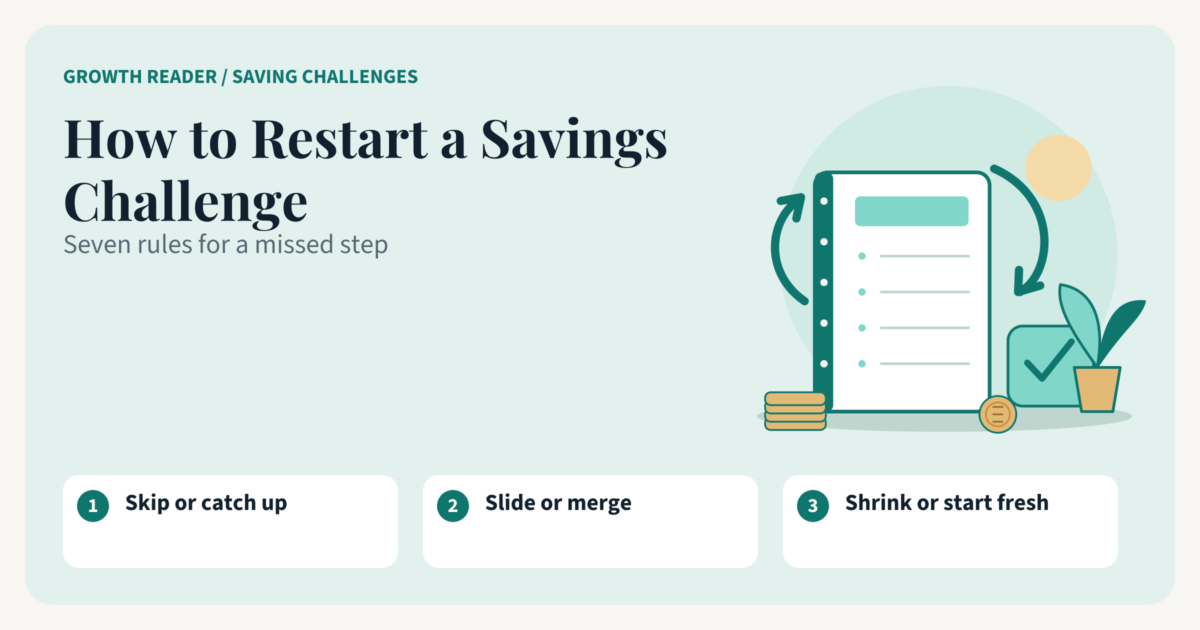
Don’t start over from week 1. When you fall behind on a savings challenge, choose one of seven rules for the missed step. You can skip it, catch up in small pieces, slide the dates, merge two steps, shrink to a smaller size, pause on purpose or start fresh. Each one treats the missed money differently, and this guide shows what each does to your total, using one example.

Every total below is what the steps add up to if you complete every remaining step. It isn’t a prediction, and every amount is an example.

Fresh Start changes the plan, not the money you already saved. Keep that money in your challenge place and record it separately from the new challenge’s steps.
A missed step is information
A missed step tells you something about that week: a bill landed, hours dropped, a trip came up. It doesn’t tell you who you are. Most challenge charts have no rule for it, so the gap looks like proof of failure.
What research can say here is limited. In a 2010 study, 96 volunteers each chose an eating, drinking or activity behavior and did it daily in the same situation for 12 weeks. The time it took to reach 95 percent of each person’s automaticity plateau ranged from 18 to 254 days. Missing one opportunity to do the behavior did not materially affect the habit formation process. Doing it more consistently was associated with a better fit to the authors’ model (How are habits formed: Modelling habit formation in the real world). That study was about everyday habits, not saving, so take it as a reason for patience, not as a promise.
One example, seven rules
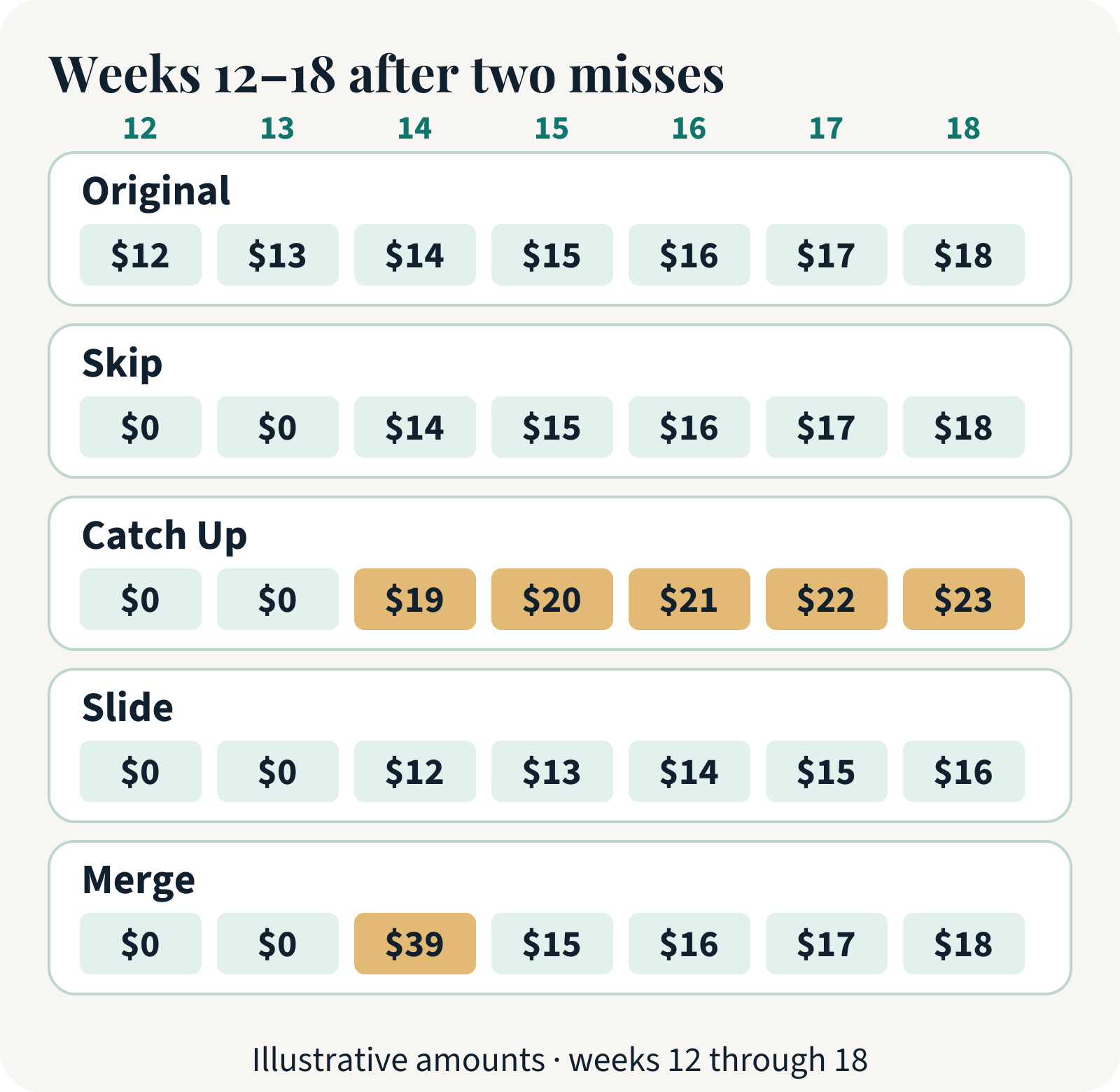
Dara is doing the 52-week count-up at a $1 step, which totals $1,378 if every week is completed. Dara misses weeks 12 and 13, which would have been $12 and $13, a total of $25. By week 11 Dara had saved $66. Here is what each rule does.
| Rule | What Dara does | Total if finished | Ends |
|---|---|---|---|
| Skip | Leaves out $12 and $13 and keeps going | $1,353 | Week 52 |
| Catch Up | Adds $5 to each of weeks 14 to 18 | $1,378 | Week 52 |
| Slide | Moves every remaining step two weeks later | $1,378 | Week 54 |
| Merge | Saves $25 plus the $14 step in week 14 | $1,378 | Week 52 |
| Shrink | Switches to the low size from week 14 | $387.75 | Week 52 |
| Pause | Declared before week 12, then resumes | $1,378 | Week 54 |
| Fresh Start | Keeps the $66 and starts a 12-week sprint | $144 | 12 weeks |
What each rule does
Skip. Leave out the missed steps and keep going. Your total drops by what you skipped, which was $25 for Dara. It’s the simplest fix, and it suits a small step.
Catch Up. Add the missed amount in small pieces to later steps. Dara adds $5 to each of weeks 14 to 18, so week 18 is $23 instead of $18. The total stays the same. Check each step you add to against what one pay period can safely carry. If you use automatic transfers, watch your balance so a larger transfer doesn’t trigger overdraft fees, a caution the U.S. Consumer Financial Protection Bureau makes in its guide to building an emergency fund (An essential guide to building an emergency fund).
Slide. Move every remaining step to a later date, so the missed steps happen when you can afford them. The total stays the same and the challenge ends later.
Merge. Combine the missed steps with the next one into one larger save. Dara saves $25 plus $14, which is $39 in week 14. One pay period carries more, so check it against your safe amount.
Shrink. From the next step, move down one size for the steps that remain. Dara had saved $66 by week 11. From week 14, the low size’s steps are 14 to 52 times 25 cents, which adds up to $321.75. The total is $387.75, far lower than $1,378, but it’s a challenge Dara can finish.
Pause. Before a known tight stretch, such as a large annual bill, declare a break of up to two steps. The schedule freezes and then picks up where it stopped. Because you chose it ahead of time, it isn’t a miss.
Fresh Start. After a long gap, keep what you’ve saved, choose a new start date and check your safe amount again. Dara keeps the $66 and starts the 12-week sprint at the low size, which totals $78. The place would hold $144 when it’s done.
Choose your rules before you need them
Pick two rules for each challenge: a first rule and a backup. Write them as if-then sentences. A review of 94 tests looked at plans in the form “If situation Y, then I will do X.” On average, they had a medium-to-large positive effect on reaching goals (Implementation intentions and goal achievement: A meta-analysis of effects and processes). That review looked at goals in general, not at saving in particular, but the format is easy to try.
- “If I miss a step, then I use my first rule.”
- “If I miss two in a row, then I use my backup rule.”
- “If I miss three, then I recheck my safe amount.”
| Kind of challenge | First rule | Backup |
|---|---|---|
| Count-ups that rise each week | Slide | Merge |
| Flat amounts | Catch Up | Skip |
| Envelopes and random draws | Skip | Slide |
| Paycheck-based challenges | Merge | Catch Up |
| Spending pauses | Pause | Fresh Start |
Why steps get missed
Most misses have one of four causes, and each points to a rule.
- A bill landed. A one-time cost took the money. Use Pause or Slide, and check whether your amount needs a refresh.
- Pay dropped. Hours or income fell. Use Shrink, and recheck your safe amount.
- You forgot. Nothing was wrong except the reminder. Use Merge or Catch Up, and move your if-then rule to a trigger you won’t miss.
- The challenge got dull. The numbers feel flat. Use Fresh Start with a different kind of challenge.
The three-miss check
If you miss three steps in a row, don’t try harder. Recheck your safe amount: look at your balance the day before each of your last three paydays, subtract bills still due and plan from the lowest, rounded down. The number you chose may be too high.
If you’re missing steps because essentials are going unpaid, stop the challenge for now. In the US, the National Foundation for Credit Counseling is a nonprofit with certified credit counselors and member agencies (National Foundation for Credit Counseling). Other countries have their own free services, and your government’s consumer finance site can point you to them. A paused challenge can start again. An unpaid essential is much harder to undo.
Common questions about restarting a savings challenge
Should I start over from week 1?
Usually not. Starting over gives up the steps you’ve already completed. Skip, catch up or slide first, and keep a fresh start for a long gap.
Does missing a week ruin the challenge?
No. A missed step changes your total or your end date, depending on the rule you use. The challenge is still yours to finish.
Can I switch to a smaller size?
Yes. That’s the shrink rule. Switch at a step boundary and recompute your total, as in the example above.
How do I catch up without straining my budget?
Spread the missed amount over several steps and check each pay period against your safe amount. Smaller pieces over more steps are easier than one large catch-up.
Is it okay to stop a challenge early?
Yes. Count it as complete at the size you reached, write down the total and decide what the money is for. The 52-Week Savings Challenge: Low, Medium and Reverse Versions Explained and Biweekly Savings Challenge Ideas That Match Your Paycheck show how to size a new one.
Your next step

Write your two rules and the three sentences above on the first page of your tracker, before the next step is due. The free Savings Challenge Picker can help you choose a challenge that fits, and the Savings Challenge Tracker Pack has a restart log if you’d like a ready-made place to record each missed step.
Sources and tools used in this guide
Checked on October 12, 2026. Dollar amounts in the examples are illustrative and are not forecasts, unless a source is named.
- “How are habits formed: Modelling habit formation in the real world,” Lally and others, European Journal of Social Psychology, 2010
- “An essential guide to building an emergency fund,” Consumer Financial Protection Bureau
- “Implementation intentions and goal achievement: A meta-analysis of effects and processes,” Gollwitzer and Sheeran, Advances in Experimental Social Psychology, 2006
- National Foundation for Credit Counseling
This guide is general education, not financial advice. See our Disclaimer.