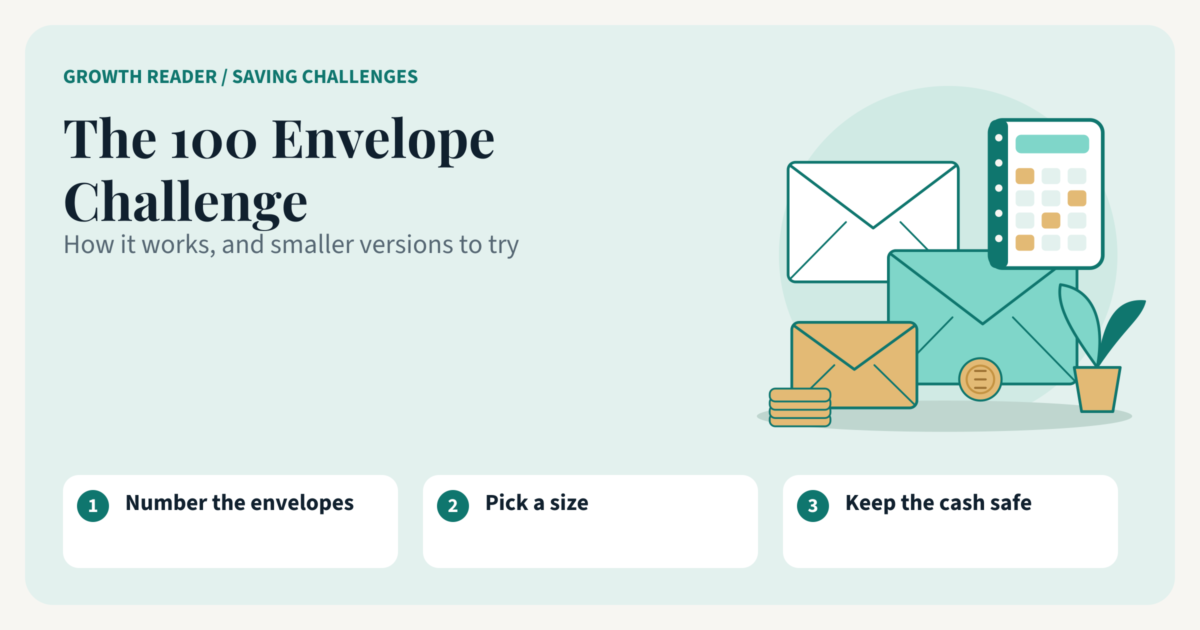
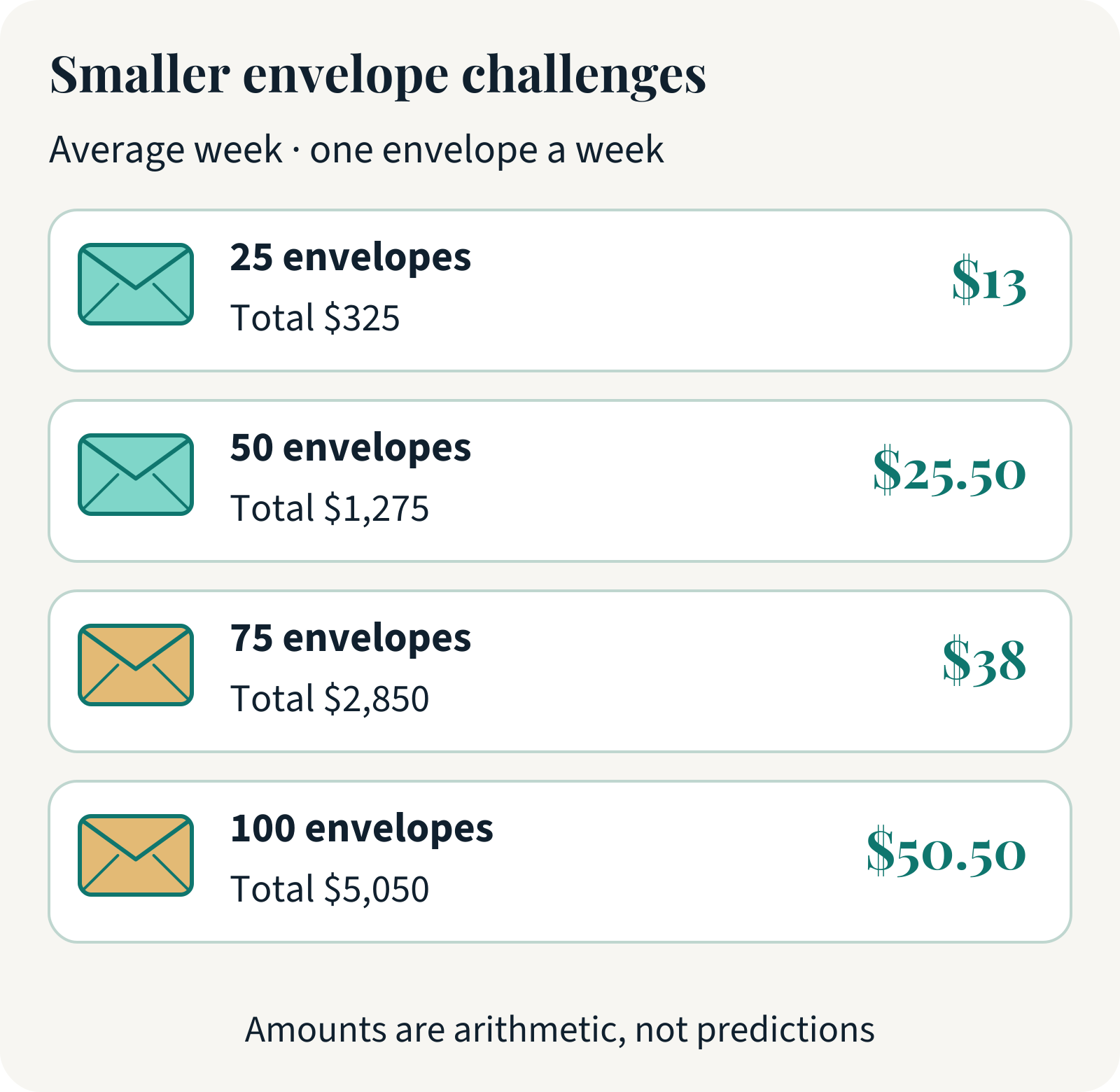
The 100 envelope challenge works like this: number 100 envelopes from 1 to 100, then fill each envelope with that many dollars, in any order you like. Envelope 1 holds $1, envelope 100 holds $100, and when every envelope is full you’ve saved $5,050. Smaller versions use fewer envelopes: 25 envelopes total $325, 50 total $1,275 and 75 total $2,850.

The challenge doesn’t have to take 100 days. The pace is yours, and the pace decides whether it fits your budget. This guide shows what each version and each pace asks of you in a typical week, how to handle a big draw in a tight week, and how to keep the cash safe or skip the cash entirely. Every total is what the steps add up to if you fill every envelope. It isn’t a prediction.
How the 100 envelope challenge works
- Number 100 envelopes (or slips of paper) from 1 to 100.
- Draw one. Fill it with that many dollars.
- Mark the number off in your tracker.
- Repeat until every envelope is full.
The total is 1 + 2 + 3 and so on up to 100, which is 100 times 101 divided by two, or $5,050. You can draw in order or at random. Random draws add surprise, and they can also put a big envelope in a tight week, which is the main thing to plan for.
Smaller versions: 25, 50 and 75 envelopes
The same pattern works with fewer envelopes. Number them 1 up to your chosen count.
| Version | Biggest envelope | Total if finished | Average week at one envelope a week |
|---|---|---|---|
| 25 envelopes | $25 | $325 | $13 |
| 50 envelopes | $50 | $1,275 | $25.50 |
| 75 envelopes | $75 | $2,850 | $38 |
| 100 envelopes | $100 | $5,050 | $50.50 |
You can also scale the amounts instead of the count. Keep 100 envelopes and multiply each number by 25 cents, 50 cents or $1.
| Amount per number | Biggest envelope | Total if finished |
|---|---|---|
| 25 cents | $25 | $1,262.50 |
| 50 cents | $50 | $2,525 |
| $1 | $100 | $5,050 |
Choose a pace
The challenge is named for 100 envelopes, not for a number of days. The pace changes the weekly commitment a lot.
| Pace for 100 envelopes | Weeks to finish | Average week |
|---|---|---|
| One a day (100 days) | About 14.3 | $353.50 |
| Three a week | About 33.3 | $151.50 |
| Two a week | 50 | $101 |
| One a week | 100 | $50.50 |
At a daily pace, the challenge asks for about $353.50 in an average week. That’s a very large commitment for most budgets. If you like the idea of the 100 envelope challenge but not the weekly cost, a smaller version or a slower pace is the honest way to fit it to your pay.
Handle a big draw in a tight week
Two checks help you choose a size. The first is the average test: does the average week fit your safe weekly amount? The second is the peak test: could the biggest pay period come out of your safe amount for one paycheck?
With random draws, the peak can be worse than the biggest single envelope, because the two largest envelopes can land in the same pay period.
| Version | Two biggest envelopes together |
|---|---|
| 25 envelopes | $49 |
| 50 envelopes | $99 |
| 75 envelopes | $149 |
| 100 envelopes | $199 |
Write a swap rule before you start: “If a draw is more than I can afford this week, I put it back and draw again. If it’s still too big, I take the smallest envelope left.” A swapped envelope stays in the pile for a better week.

EXAMPLE: Jo is paid every two weeks, and one pay period can safely hold $50. The 50 envelope version fails the check, because its two biggest envelopes together are $99. Jo picks the 25 envelope version, where they total $49, and writes the swap rule on the first envelope. Jo fills one envelope a week. The first four draws are $17, $22, $6 and $9, which add up to $54. The first two land in one pay period and add up to $39, which fits. Jo keeps going.
Keep the cash safe
Keep envelope money in one spot, record every addition, set a limit you could afford to lose and count once a month.
Cash isn’t covered by deposit insurance. In the US, deposit insurance from the Federal Deposit Insurance Corporation covers deposits at insured banks, up to $250,000 per depositor, per insured bank, for each account ownership category. It covers deposits only (Understanding Deposit Insurance). Cash at home can be lost to fire, theft or accident.
If US currency is damaged, Treasury rules say it can be redeemed at full value in some cases. That applies when clearly more than half of a note is present, or when half or less remains and the evidence shows the missing part was destroyed (31 CFR 100.7, Treasury’s redemption process). Treat that as a last resort, not a plan.
Do it without cash
Number the envelopes in a notes app, a list or a spreadsheet instead. When you draw a number, move that many dollars into a separate account. The U.S. Consumer Financial Protection Bureau describes a bank or credit union account as generally considered one of the safest places to put your money (An essential guide to building an emergency fund). A digital envelope can’t be lost or damaged, though it’s also easier to spend, so give the account a name that says what it’s for.
Track it
A grid of 100 boxes, numbered 1 to 100, works well. Cross out each number as you fill its envelope. Add four columns if you like: the envelope number, the date, the amount and the total so far. The total column catches mistakes early. The Savings Challenge Tracker Pack includes a ready-made grid.
What if you fall behind?
You can leave an envelope empty and keep going, which lowers your total by that envelope’s number. You can fill it later in small pieces. You can slide your dates. Choose one before you need it. How to Restart a Savings Challenge After You Fall Behind walks through seven options with numbers.
Common questions about the 100 envelope challenge
How much money is the 100 envelope challenge?
It totals $5,050 if you fill every envelope. Smaller versions total $325 (25 envelopes), $1,275 (50) and $2,850 (75).
Can I do the 100 envelope challenge in less than 100 days?
You can, and the weekly cost rises. At 100 envelopes in 100 days, an average week asks for about $353.50. Check that against your budget first.
What if I draw a $100 envelope in a tight week?
Use a swap rule you wrote in advance: put it back and draw again, or take the smallest envelope left.
Do the envelopes have to hold cash?
No. You can number them on paper and move the money into a separate account when you draw.
Is there a smaller version of the 100 envelope challenge?
Yes. Use 25, 50 or 75 envelopes, or keep 100 envelopes and multiply each number by 25 or 50 cents.
Your next step

Pick a version and a pace, then check the two biggest envelopes against what one paycheck can safely carry. The free Savings Challenge Picker can help you narrow the choice if you’re comparing it with other challenges.
If you prefer a reusable set of printed tracking pages, explore the Savings Challenge Tracker Pack. It is a separate paid PDF product; the free Savings Challenge Picker can also build a schedule to print.

Sources and tools used in this guide
Checked on October 12, 2026. Dollar amounts in the examples are illustrative and are not forecasts, unless a source is named.
- “Understanding Deposit Insurance,” Federal Deposit Insurance Corporation
- 31 CFR 100.7 (Treasury’s redemption process), Legal Information Institute, Cornell Law School
- “An essential guide to building an emergency fund,” Consumer Financial Protection Bureau
This guide is general education, not financial advice. See our Disclaimer.