The 52-week savings challenge has you save one step in week 1, two steps in week 2, and so on up to 52 steps in week 52. At a $1 step, the total is $1,378. At a 25 cent step it’s $344.50, and at a $2 step it’s $2,756. The reverse version starts with the biggest step and counts down. The only real difference between the versions is when the hard weeks arrive, and that decides which one you can finish.

This guide shows the arithmetic for each size, where the money actually sits in the year, how to check that a size fits your pay, and how to adapt the challenge to biweekly paychecks. Every total is what the steps add up to if you complete every one. It isn’t a prediction.
How the 52-week challenge works
Pick a step: the amount you add each week. In week 1 you save one step. In week 2 you save two steps. In week 52 you save 52 steps. The total is the step times 1,378, because 1 + 2 + 3 and so on up to 52 adds up to 1,378.
| Size | Your step | Average week | Biggest week | Total if finished |
|---|---|---|---|---|
| Low | 25 cents | $6.63 | $13 | $344.50 |
| Medium | $1 | $26.50 | $52 | $1,378 |
| High | $2 | $53 | $104 | $2,756 |
The medium size is the classic $1 version. The low and high sizes use the same pattern with a different step. The average week is the total divided by 52.
Where the money sits
Most of the money in this challenge sits in the second half of the year. At the medium size, the first 26 weeks add up to $351. The last 26 weeks add up to $1,027, which is nearly three-quarters of the total. The final 13 weeks alone ask for $598.
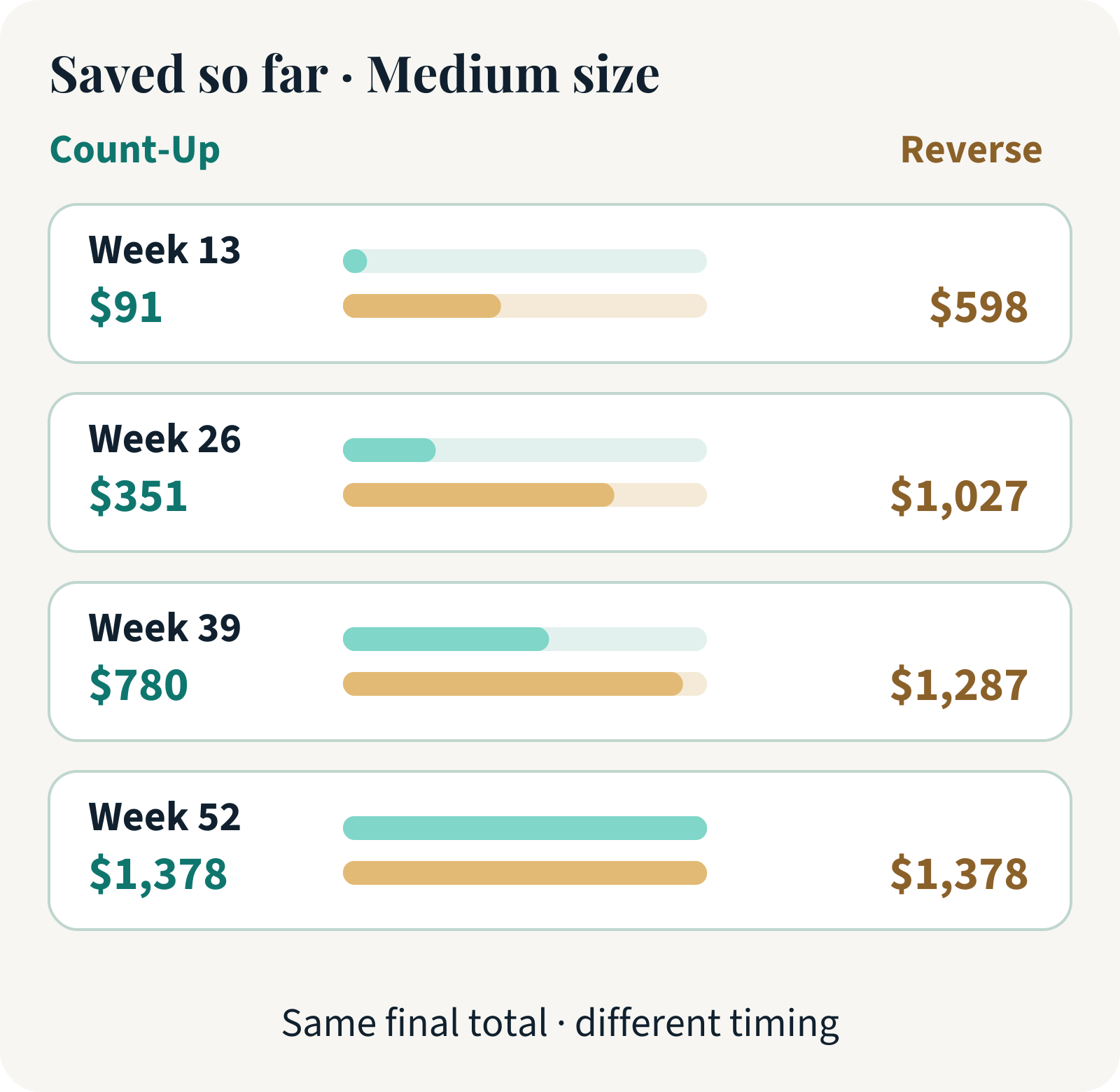
| Saved so far (medium size) | Week 13 | Week 26 | Week 39 | Week 52 |
|---|---|---|---|---|
| Count-up | $91 | $351 | $780 | $1,378 |
| Reverse | $598 | $1,027 | $1,287 | $1,378 |
The reverse version

The reverse 52-week challenge starts at 52 steps in week 1 and drops by one step each week, so week 52 is a single step. The total is the same. What changes is the shape of the year: the big saves come first, when a fresh start makes them easier, and the last weeks are tiny. At the medium size, the final 12 weeks add up to just $78.
It suits you if you’d rather do the hard part while your motivation is high, or if you expect money to be tighter later in the year. It asks the most of you at the start. If you’re paid every two weeks, weeks 1 and 2 together are $103 at the medium size, so check that against your safe amount for one paycheck before you begin.
Pick a size that fits your pay
Two checks keep you from choosing a size you can’t finish.
- The average test. Compare the average week with the amount you can move each week without touching your bills.
- The peak test. Find the pay period that holds the biggest save and compare it with your safe amount for one paycheck.
EXAMPLE: Marisol is paid every two weeks and can safely move $30 a week, which is $60 a paycheck. The medium count-up averages $26.50 a week, so it passes the first check. Its last pay period, weeks 51 and 52, adds up to $103, which is above $60, so it fails the second. The low size passes both. The same $1,378 as a flat amount is $26.50 a week, which is $53 a paycheck, and it passes both too. The flat version keeps the total and removes the hard end.
Adapt it to biweekly pay
If you’re paid every two weeks, save two weeks of steps at each paycheck. Payroll tables count 26 pay periods a year for biweekly pay (Publication 15-T (2026), Federal Income Tax Withholding Methods), so the 52 weeks fit into 26 paychecks. Paycheck 1 covers weeks 1 and 2, paycheck 2 covers weeks 3 and 4, and so on.
| Paycheck | Weeks covered | Save at a $1 step |
|---|---|---|
| 1 | 1 and 2 | $3 |
| 2 | 3 and 4 | $7 |
| 3 | 5 and 6 | $11 |
| 13 | 25 and 26 | $51 |
| 26 | 51 and 52 | $103 |
Paycheck k asks for 4k minus 1 steps, and the 26 paychecks add up to the same $1,378. If that last paycheck is too big, a challenge built for biweekly pay may suit you better. Biweekly Savings Challenge Ideas That Match Your Paycheck covers them.
Make the challenge easier to keep
Three habits help any version.
Give the money a place. Keep it apart from spending. The U.S. Consumer Financial Protection Bureau says recurring transfers from checking to savings are often one of the easiest ways to save consistently. It also advises that you watch your balance so an automatic transfer doesn’t trigger overdraft fees (An essential guide to building an emergency fund).
Write an if-then rule. A review of 94 tests looked at plans in the form “If situation Y, then I will do X.” On average, they had a medium-to-large positive effect on reaching goals (Implementation intentions and goal achievement: A meta-analysis of effects and processes). That review looked at goals in general, not at saving in particular, but a rule like “If it’s payday, then I move this week’s steps before I spend anything” is easy to try.
Plan for a missed week. Choose your response before it happens. How to Restart a Savings Challenge After You Fall Behind shows seven options with the arithmetic.
Common questions about the 52-week savings challenge
How much do you save in the 52-week challenge?
At a $1 step it’s $1,378 if you complete every week. At a 25 cent step it’s $344.50, and at a $2 step it’s $2,756.
Is the reverse 52-week challenge better?
Neither is better. The reverse version puts the biggest saves first. The count-up version puts them last. Choose the one whose hard weeks fit your year.
What if I fall behind?
A missed week is information, not failure. You can skip it, catch up in small pieces, slide the dates, merge two weeks or shrink to a smaller size.
Can I do the 52-week challenge if I’m paid every two weeks?
Yes. Save two weeks of steps at each paycheck. The table above shows the amounts at a $1 step.
Do I have to start in January?
No. Start on any date, and write your own start date at the top of the schedule.
Is there a smaller version?
Yes. The low size uses a 25 cent step and totals $344.50. A shorter 12-week version is also an option.
Your next step

Pick a size, find the pay period that holds your biggest save, and compare it with what one paycheck can safely carry. The free Savings Challenge Picker can help you narrow the choice. A Savings Challenge Tracker Pack sheet gives you a ready-made list for the 52 weeks, or you can draw four columns in a notebook: the week, the date, the amount and the total so far.

Sources and tools used in this guide
Checked on October 12, 2026. Dollar amounts in the examples are illustrative and are not forecasts, unless a source is named.
- Publication 15-T (2026), Federal Income Tax Withholding Methods, Internal Revenue Service
- “An essential guide to building an emergency fund,” Consumer Financial Protection Bureau
- “Implementation intentions and goal achievement: A meta-analysis of effects and processes,” Gollwitzer and Sheeran, Advances in Experimental Social Psychology, 2006
This guide is general education, not financial advice. See our Disclaimer.