Wanting to spend less on the holidays is common. Worrying that it will look stingy is common too. Nobody wants to be the person whose gift says “I didn’t try.”
But cheap and careful aren’t the same thing. Cheap cuts the care. Careful cuts the cost and keeps the parts people actually notice: attention, time, and a gift or gesture that fits them. Every idea below works that way, and every one can be used this season without buying anything first.
You don’t need all 25. Read through, pick the three or four that fit your biggest costs, and start there.
Start with a plan
1. Set one total from money you actually have
The fastest way to spend less is to decide in advance how much you’ll spend. Build your total from the holiday money you already have plus what you can set aside from each paycheck before mid-December, after bills, minimum payments and emergency savings. Then split it across gifts, travel, food and hosting, and extras.
A total that fits means you can say yes to the things that matter without worrying about January. Our guide to planning a holiday budget for gifts, food and travel walks through it step by step, and our free holiday budget calculator checks that your payment dates fit the money you have.
2. Give every person an amount before you choose a gift
Gift lists usually grow because the amount is decided at the shelf. Decide it at home instead: start from your gift total, group people into tiers, and give each tier an amount. Write the amounts down, on paper or in a holiday spending planner, then shop for a gift at or under each one. Our guide to how much to spend on each person shows a quick way to set them.
3. Keep a small buffer for surprises
Most seasons bring a few: an extra guest, a host gift you didn’t expect, a price that went up. Set aside a buffer of about 10% of your total, or a fixed $25 to $50 if your total is small. Then a surprise has somewhere to go besides a credit card, and you can be gracious about it instead of stressed.
Gifts
4. Suggest a name draw with a limit
In a family of six adults who each buy for the other five at $40, everyone spends $200. With a name draw at the same $40 limit, everyone spends $40 and still gives one gift they’ve thought about.
Raise it early, before anyone starts shopping, and make it about the group:

Try saying
“We’re keeping things simpler this year. Would everyone be up for drawing names, so each of us buys one gift with a $40 limit? I’d still love to get together.”
Others may be relieved someone said it.
5. Make it kids only
Many families stop exchanging gifts between adults and focus on the children. It can make the day feel lighter, not smaller.
Try saying
“Could we do gifts for the kids only this year? Then we can spend more of the day together and less of it shopping.”
6. Give one gift per couple or household
One well-chosen gift for a couple or a family, such as a board game, a food basket or tickets to something they can do together, can feel more generous than two small separate ones, and you only need to budget one amount instead of two.
7. Go in on a bigger gift together
If a parent or friend wants one larger thing, pool your amounts with siblings or friends. Each person stays within their own amount, and the gift is something the person will love rather than three small things they didn’t ask for. Agree on who buys it and how everyone pays them back before it’s ordered.
8. Give time, with a date on it
An afternoon of babysitting, a meal you cook together, a hike, a day helping with a project: time can be the gift people remember. What keeps it from feeling like a token is detail. Put a specific plan and a date in the card (“Saturday the 17th, I’m taking the kids to the park so you can have the afternoon”), not a vague “IOU.”
9. Make something people will use up
Homemade food gifts, such as cookies, spiced nuts, granola or a soup mix in a jar, are personal and get used. Two things keep them from costing more than you expect:
- Count everything: ingredients, jars, ribbon, labels and postage. Batching one recipe for many people keeps the cost of each gift down.
- Ask about allergies before you give food.

10. Buy secondhand or refurbished where it makes sense
Books, toys, games, tools, sports gear and some electronics can often be found in good condition for less. Check the condition carefully, and check the return terms before you buy, because they can differ from new items. Some people love a well-chosen secondhand find; if you’re not sure about someone on your list, save this idea for the people you know will.
11. Read the terms before you buy a gift card
Gift cards are easy to give and easy to keep within an amount. In the US, federal rules limit how soon most store gift cards can expire and when inactivity fees can start, but terms still vary, so read them before you buy (CFPB, Regulation E).
If a store offers a bonus card when you buy a gift card, such as an extra $10 with a $50 card, remember that the gift card is still part of your plan at full price. Bonus cards can come with their own terms, including dates when they can be used. It’s only a saving if you’d use it in time anyway.
Food and hosting
12. Plan the meal to the guest count
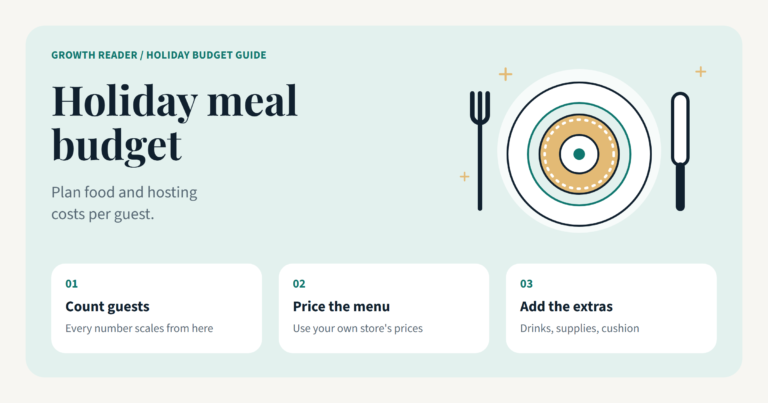
Divide the money for a gathering by the number of guests to get a per-guest amount, then plan the menu to fit it. Fewer dishes made well can feel more generous than a crowded table of things nobody finishes. The per-guest amount also tells you what one more guest costs, so “can I bring someone?” becomes an easy yes or a kind no.
13. Make it a potluck, with a specific ask
Sharing the cooking is one of the biggest levers you have. Suppose hosting a dinner for 10 would cost $250, or $25 a guest. If you cover the main dish and drinks for $140 and guests bring the rest, your share drops to $14 a guest.
The difference between a potluck that works and one with five desserts is a specific ask:
Try saying
“We’ll do the main dish and drinks. Could you bring a side that serves about eight?”
14. Borrow before you buy
Folding chairs, a big roasting pan, extra serving dishes, a punch bowl: many hosting items get used once a year. Ask family, friends or neighbors first, or check a local free-swap group. Return things clean and with a thank-you, and you’ll be able to ask again next year.
15. Change the format, not the gathering
If a full dinner doesn’t fit this year, keep the get-together and change its shape: a brunch, a dessert-and-games evening, an afternoon open house or a cookie swap where everyone brings one kind and goes home with a mix. Each of these keeps the part that matters: being together.
Travel
16. Price the whole trip and compare your options
A trip costs more than the ticket. Add up getting there and back (fares or gas, bags, tolls), getting around at the other end, a place to stay, food on travel days, and costs at home while you’re away, such as pet care. Then compare at least two options with every cost included: driving versus flying, or two different sets of dates. Prices can differ a lot between options, and the only way to know is to price them.
17. Set a book-at price, or change who travels
Decide the most you’ll pay, then book when the price is at or under it and the money is in your holiday account. After that, stop checking.
If the trip doesn’t fit at any price this year, there are other honest options: host instead and invite people to you, take turns traveling with other family members, or visit at a different time of year and make that visit the celebration.
Decorations and celebrations
18. Refresh what you have instead of starting over
Bring out last year’s decorations before you buy anything. Rearrange them, add greenery, pine cones or dried orange slices, and choose one new piece if your plan has room. If after-season sales come around and you know you’ll need something next year, buy it then, and only if the money is in that season’s plan.
19. Rethink cards and postage
Printed cards, stamps and shipping add up quietly. You could send printed cards to the few people who treasure them and a photo or message by email to everyone else, or write fewer cards with a real line in each. A handwritten note saying one specific thing you appreciate about someone can matter more than a stack of signed cards.
20. Build traditions around free things
Some of the most-loved holiday traditions cost little: walking or driving around to see lights, a library or community event, a movie night at home with a homemade snack, a baking afternoon, a game night, or volunteering together. Check your library’s and town’s events calendars for the season, and ask your kids which traditions they’d most like to keep, and make room for their answers.
Shopping and paying
21. Note today’s prices, then shop from your list
A “deal” label doesn’t tell you whether a price is good. When the UK consumer group Which? checked 227 Black Friday deals at eight large UK retailers, it found that about nine in ten were the same price or cheaper at other times of the year (Which?, 2024). That was one UK check of one sales period, so it doesn’t mean every deal is a bad one. It does mean your own notes are a better guide than the label.
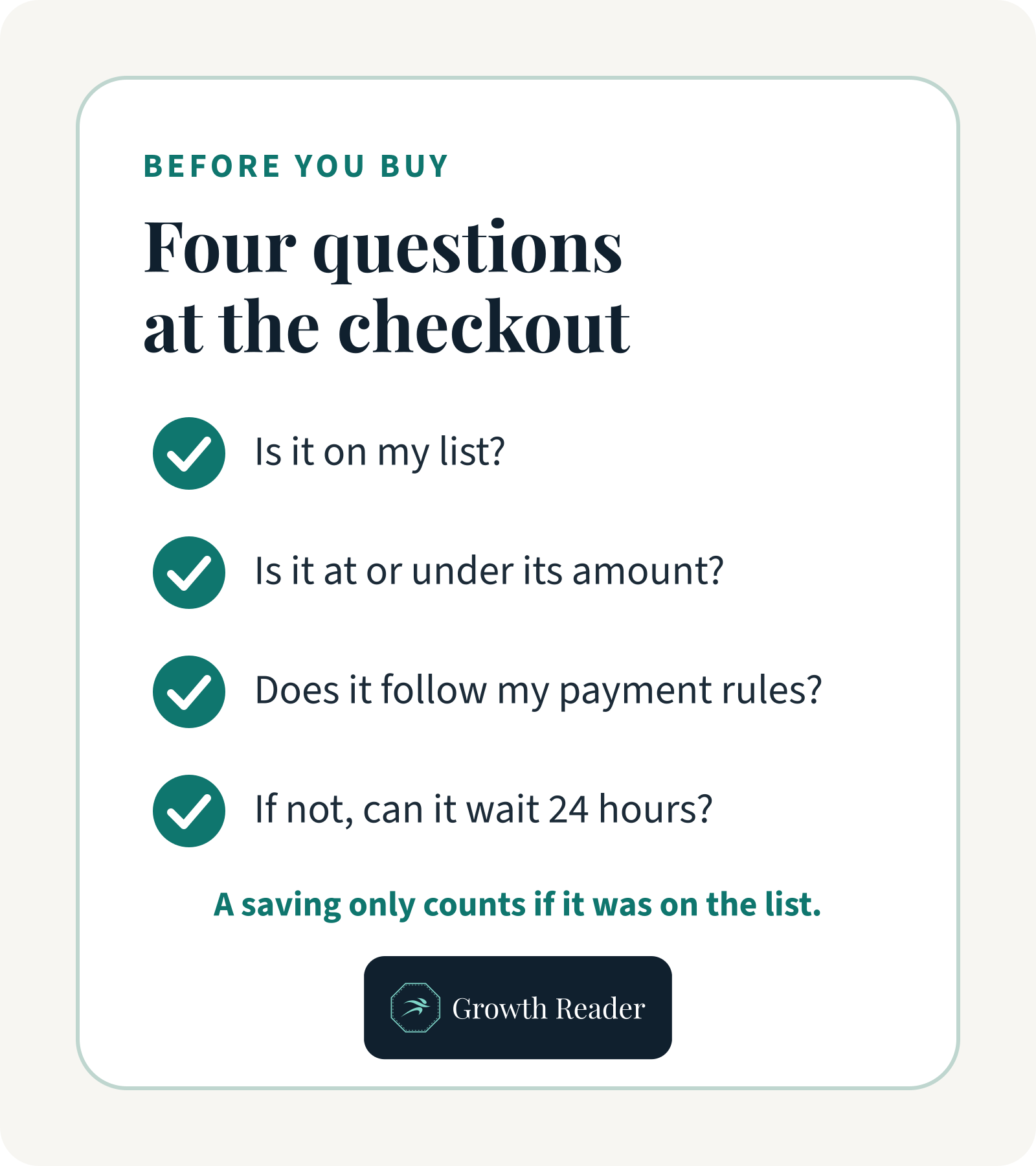
Before the big sales, write down today’s price for the main items on your gift list. If a store or price-tracking tool shows an item’s price history, look at that too. Then shop from the list: a saving only counts if the item was already on it. When you do pay less than you planned, move the difference to your buffer instead of letting it buy something extra.
Keep every receipt in one place, and note each item’s last return date, in a notes app or a holiday spending tracker. Return windows and price-adjustment policies vary by store, so check each one.
22. Use a 24-hour rule for anything not on the list
Sales often push you to decide now: countdown timers, “today only” banners, “3 left in stock.” Give yourself a simple rule instead. If something isn’t on your list, wait 24 hours. If you still want it tomorrow, decide whether it fits your plan and where the money would come from.
23. Watch free-shipping minimums, and order early
Free-shipping minimums are a common way to add things you didn’t plan. If an order is $8 short of free shipping and shipping costs $6, paying the $6 is cheaper than adding a $15 item you didn’t need. Compare the two before you add anything.
Late orders cost more too, because they need faster shipping. Check each store’s and carrier’s posted holiday shipping dates, and order early enough for standard delivery. If you do end up paying for express shipping, take it from the buffer and make a note to order earlier next year.
24. Decide how you’ll pay before the sales start
Payment decisions made at the checkout are rarely the ones you’d make at home. Write two or three rules now, such as “holiday costs come from the holiday account,” “if we use a credit card, we only charge what’s already in the holiday account and pay the full statement balance from it,” and “no new store cards this season.” Our ebook The Holiday Spending Plan gives payment rules a full chapter.
25. Make shopping a little less convenient
Store emails and app notifications pile up in the holiday season, and each one is an invitation to browse. For the next few months, unsubscribe from the store emails you don’t need or filter them into a folder you only open when you’re shopping from your list, turn off shopping app notifications until January, and remove saved card details from shopping sites so every purchase takes one extra step.
None of this is about willpower. It just makes your list the easiest thing to follow.
Where to start if you want to spend less on the holidays
Pick three ideas from this list: one for your biggest cost (usually gifts), one for food or travel, and one shopping habit. Write them into your plan this week, and tell anyone they affect early. A few clear changes decided now are easier to plan around than big cuts made in a hurry in December. If you’d like the whole system in one place, the holiday spending bundle brings together the ebook, the planner and the tracker.
Related guides: Holiday Travel Budget: How to Count the Whole Trip Before You Book · Holiday Meal Budget: How to Plan Food and Hosting Costs Per Guest · How to Plan a Holiday Budget for Gifts, Food and Travel · Holiday Gift Budget: How Much to Spend Per Person
This article is general information, not financial advice. See our Disclaimer. The examples are invented, and their amounts are illustrations, not recommendations.