“How much should I spend on each person?” is one of the most common holiday money questions, and the honest answer is that there isn’t a standard amount. What a coworker spends on her sister, or what you spent on yours last year, can’t tell you what fits this season.
What can tell you is your holiday gift budget. Once you know the total you have for gifts, then a few minutes of simple math gives every person on your list an amount, with more for the people closest to you and a fair share for everyone else. This guide walks through it with one worked example, then covers what to do when the list is longer than the money.

Quick answer
There’s no correct amount per person. Instead, the right amount comes out of a gift budget you can pay for. To find it: (1) start with your total gift budget, (2) list everyone, (3) take out the small gifts that already have a fixed amount, and (4) share the rest among everyone else by tier using points, then round down and check that it adds up.
National averages give some context, but they aren’t per-person amounts. In the National Retail Federation’s 2025 holiday survey, US shoppers planned to spend about $628 each on gifts for family and friends across the whole season (NRF, October 2025). PwC’s 2026 Holiday Outlook put the average expected gift spend at $708, with households with children expecting $875 and households without children $635 (PwC, September 2026). Those are totals across everyone a shopper buys for, and they’re averages of what people planned. Your own number comes from your own paychecks.
Step 1: Start with your holiday gift budget, not your list
Most gift lists are built from the bottom up: think of a person, think of a gift, see what it costs, repeat. The total only shows up at the end, usually bigger than expected.
So this method works from the top down. Start with one number: the money you have for all the gifts you’ll give this season. It should come from money you can spend without touching rent, bills, minimum debt payments or emergency savings. If you haven’t set a holiday total yet, our guide to planning a holiday budget for gifts, food and travel shows how to build it from your paychecks and split it, so you know exactly how much is for gifts. Our free holiday budget calculator can then check that your payment dates fit the money you have.
Write the number at the top of your list, on paper, in a notes app or in a holiday spending planner. Then every amount below comes out of it.
Step 2: List everyone, including the people lists forget
Write down every person you expect to give a gift to. Start with family and close friends. Then go through the group where lists usually leak:
- teachers, coaches and childcare providers
- people you thank at the end of the year, such as a babysitter, a dog walker or a neighbor who helps
- coworkers and any work gift exchange
- hosts of gatherings you’ll go to
- family gift exchanges
Then add one or two spare gifts: small, general gifts bought ahead for the surprises most seasons bring, such as a guest who arrives with something for you or a name added to an exchange. A spare bought calmly in November also keeps a surprise from turning into a rushed purchase on December 23.
Step 3: Take out fixed-amount gifts first
Some gifts already have an amount. A work exchange often comes with a limit. A family draw might too. You may give the same small gift to every teacher, and your spares also have a set amount by definition. So put these in Tier 4: thank-yous, hosts, exchanges and spares.
Add up Tier 4 and subtract it from your gift budget. What’s left, then, is the money you’ll share among everyone else.

Example
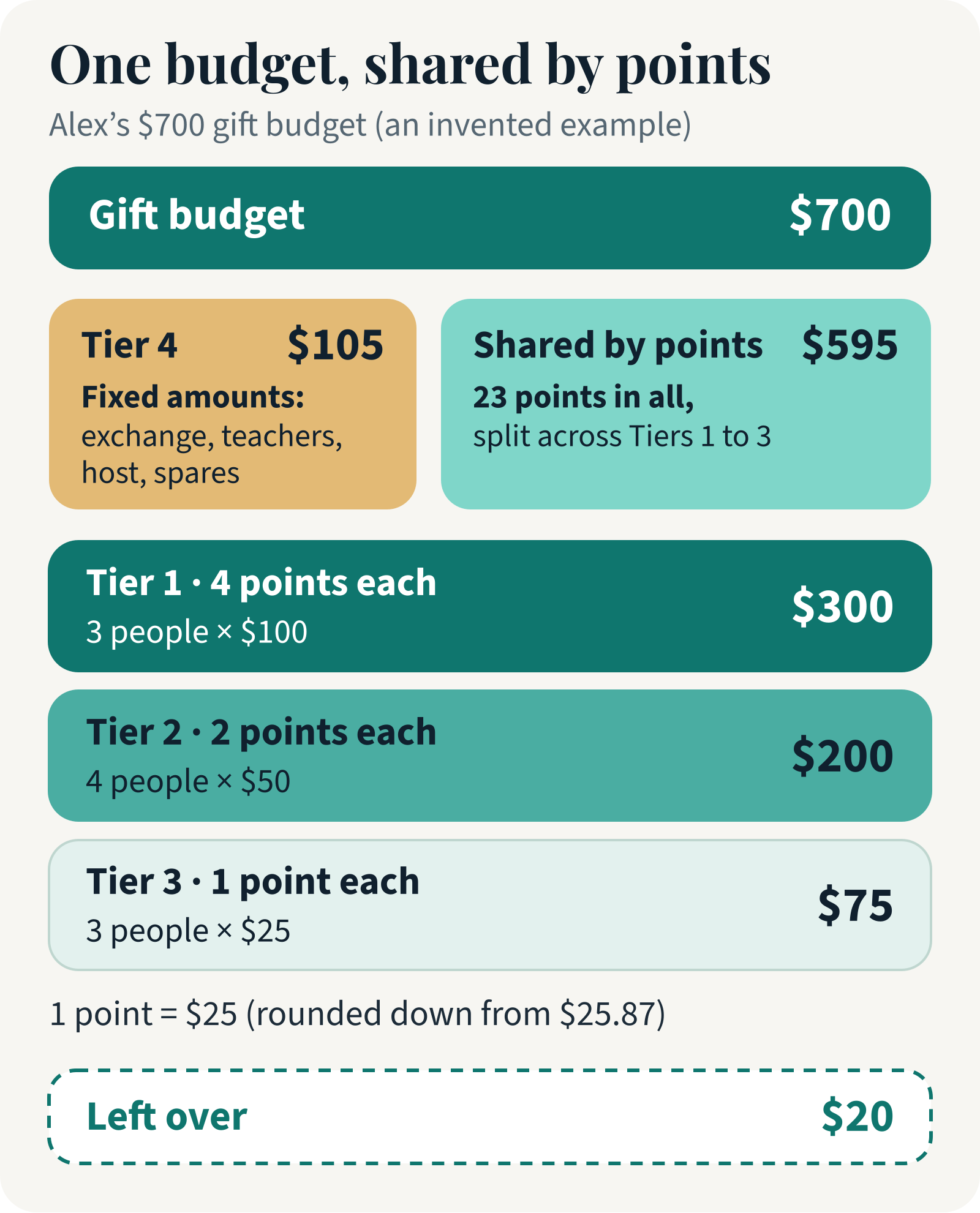
Alex (an invented example) has a $700 gift budget. Tier 4 is a work exchange ($25), two teacher gifts ($15 each), one host gift ($20) and two spare gifts ($15 each): $105 in total. So that leaves $595 to share.
Step 4: Share the rest by tier, using points
Deciding an amount for each person one by one is slow, and it also invites second-guessing. Group everyone else into three tiers instead, and give each tier a number of points:
| Tier | Who’s in it | Points each |
|---|---|---|
| 1 | Your closest people, often a partner and children | 4 |
| 2 | Close family and close friends | 2 |
| 3 | Wider family, friends’ children and people you give smaller gifts to each year | 1 |
Points are GrowthReader’s simple way to share money unevenly but fairly. They’re a starting point rather than a rule. Then:
- Add up the points. Count the people in each tier and multiply by that tier’s points.
- Find the value of one point. Divide the money left from step 3 by the total points.
- Round down to a friendly number. Rounding down leaves a little room in your gift budget.
- Multiply. Each person’s amount is their tier’s points times the value of one point.
- Check the sum. Add every amount, including Tier 4. It should still be at or under your gift budget.
A worked example with points
Example
Alex’s Tier 1 is a partner and two children (3 people × 4 points = 12). Tier 2 is both sets of parents (one shared gift each), a sister and a best friend (4 × 2 = 8). Tier 3 is a niece, a nephew and a grandmother (3 × 1 = 3). So that’s 23 points. $595 ÷ 23 = $25.87, which Alex rounds down to $25 a point. Tier 1 gets $100 each, Tier 2 $50 each and Tier 3 $25 each.
| Person | Tier | Amount |
|---|---|---|
| Partner | 1 | $100 |
| Child, 9 | 1 | $100 |
| Child, 6 | 1 | $100 |
| Alex’s parents (one shared gift) | 2 | $50 |
| Partner’s parents (one shared gift) | 2 | $50 |
| Sister | 2 | $50 |
| Best friend | 2 | $50 |
| Niece | 3 | $25 |
| Nephew | 3 | $25 |
| Grandmother | 3 | $25 |
| Work gift exchange | 4 | $25 |
| Two teacher gifts | 4 | $30 |
| Host gift | 4 | $20 |
| Two spare gifts | 4 | $30 |
| Total | $680 |
Alex’s list comes to $680, which leaves $20 in the gift budget for a price that goes up. If Alex had split $700 evenly across all 16 gifts, everyone would get about $44, which is too little for the children and more than the exchange allows. Points, however, fix that without changing the total.
Adjusting the points
Change the points to fit your family. If the children’s gifts matter most this year, give Tier 1 five points. If Tier 3 is long, you can instead make it half a point each. The method still works because the value of a point is recalculated from the same money.
If you’ve already bought some gifts, write down what you paid, subtract it from your gift budget, and run the points on the people who are left.
If a point is worth very little, or your Tier 1 amount feels too small to be useful, the list is longer than the money. But that’s not a math problem. Instead, it’s a sign that a gift tradition needs to change.
When the list is longer than the money
If no amount of adjusting makes the list fit, change how your group gives, not just how much. The most common changes:
- A name draw. Each adult buys for one person, with a limit. In a family of six adults who each buy for the other five at $40, everyone spends $200. With a draw at the same $40 limit, however, everyone spends $40.
- Kids only. Adults stop exchanging gifts with each other and focus on the children.
- A spending cap. Everyone agrees on the same limit per gift.
- One gift per household. Families give to each other as a group, not person by person.
- An experience instead of gifts. The group spends on a shared meal or outing.
Raising it can feel awkward, but others may feel the same and be glad someone said it. Keep it short, make it about the whole group, and suggest it early, before anyone starts shopping. Some words you can adapt:
- For a name draw: “We’re keeping things simpler this year. Would everyone be up for drawing names, so each of us buys one gift with a $40 limit? I’d still love to get together.”
- For kids only: “Could we do gifts for the kids only this year? Then we can spend more of the day together and less of it shopping.”
- For a cap with one person: “Can we agree on $50 for each other this year? It’ll help me keep the season on track.”
If someone says no, that’s fine. Thank them, keep your own amount, and give within it. A smaller gift chosen with care is still a real gift.
Special cases
A few situations come up on most lists. Our ebook The Holiday Spending Plan covers these and more in its gift chapter, and the holiday spending bundle pairs it with the planner and the tracker.
Children’s wish lists
Kids’ lists can be long and specific. Choose one main gift that fits the amount, then add smaller items or an experience if there’s room. Older children can also help: tell them the amount and let them choose within it.
Siblings
Decide what “fair” means in your house, such as the same amount or the same number of gifts, and keep to it. Deciding once saves you from re-deciding with every purchase.
Your partner
Agree on an amount for each other, or agree on no gifts and a shared outing instead. Either works if you both decide before shopping.
Coworkers
Follow the exchange limit if there is one. You don’t need to give to everyone you work with, and a card with a specific thank-you is a complete gift.
Teachers, childcare and service workers
Customs vary by place and by workplace, and some schools and employers have their own gift policies, so check before you buy. Rather than looking for a “correct” amount, set one fixed amount for the whole group and divide it in a way that feels fair. A handwritten note that says what the person did for you is meaningful at any amount.
Someone gives you a much bigger gift
You don’t need to match it, this year or next. Thank them warmly. Gift-giving isn’t a trade.
Choose gifts that fit the amount
Only now do you pick gifts. Then write one idea next to each name, at or under the amount, and two ideas for the people who matter most, in case the first one sells out or goes up in price.
- Ask. Many people are happy to share a short wish list. Ask for a few items at different prices, so you can choose one that fits.
- Think about use. Something a person will use up or use often, such as a favorite food, a hobby supply or a better version of something they use every day, often lands better than a surprise they have to find space for.
- Give time together. A meal, an outing or an afternoon of help can be a gift. Price it like any other.
- Count handmade gifts honestly. Materials, packaging and postage all count. A handmade gift can cost more than a store-bought one once you add them up.
- Read gift card terms. In the US, federal rules limit how soon most store gift cards can expire and when inactivity fees can start, but terms still vary, so read them before you buy (CFPB, Regulation E). Also, bonus cards that come free with a gift card purchase can have their own, shorter dates.
- Decide where shipping goes. If a gift has to travel, either include the postage in that person’s amount or count it in your holiday extras. Choose one, so it doesn’t get missed.
Shop from your list when the sales arrive
When the sales arrive, shop from this list, and record what you actually pay against each amount, in a notes app or a holiday spending tracker. After all, a saving only counts if the item was already on it. For more ideas that cost less but still feel generous, see our list of ways to spend less on the holidays without feeling cheap.
Short answers
Is giving cash okay?
For many people, yes, and it’s easy to keep to the amount. If cash feels too plain, you can still pair it with a card saying what you hope they’ll use it for.
Is regifting okay?
It can be, if the gift is new, suits the person and won’t be recognized by whoever gave it to you. Then put it on your list like any other gift, at an amount of zero.
Should every child get the same amount?
Only if that’s what fair means in your family. Some families match the amount, some match the number of gifts. So pick one and keep to it.
What if my total feels too small?
Keep the total and change what goes inside it: fewer people in Tier 2, a name draw, or shared gifts for couples and households. In the end, a smaller list you can pay for usually feels better in January than a bigger one you can’t.
Related guides: Holiday Travel Budget: How to Count the Whole Trip Before You Book · Holiday Meal Budget: How to Plan Food and Hosting Costs Per Guest · How to Plan a Holiday Budget for Gifts, Food and Travel · 25 Ways to Spend Less on the Holidays Without Feeling Cheap
This article is general information, not financial advice. See our Disclaimer. The example is invented, and its amounts are illustrations, not recommendations.